PHD‑Hand
Printable Humanoid Dexterous Hand
A dexterous humanoid hand with three actuated degrees of freedom in every digit, driven entirely by linkages. A single 3D-printed flexure hinge at the root of each digit keeps the part count low enough to build on a budget 3D printer, at close to human size.
Open-source release coming soon
Specifications
- Digits
- 1 thumb + 4 fingers
- Actuated DOFs per digit
- 3: two at the root, one for the coupled upper joints
- Total actuated DOFs
- 15
- Drivetrain
- Fully linkage-driven, no tendons or gear trains
- Root joint
- 2-DOF TPU flexure hinge
- Upper joint coupling
- Cross 4-bar, ratio 0.77
- Hand length
- About 200 mm
- Major parts per digit
- 18
- Actuators
- Generic mini RC servos, mounted off the digits
- Controller
- Pololu Mini Maestro 18
- Backdrivable
- Yes, every DOF in both directions
- Testing so far
- About 200 hours on one prototype
The flexure hinge
The one part that makes a fully linkage-driven 3-DOF digit simple.
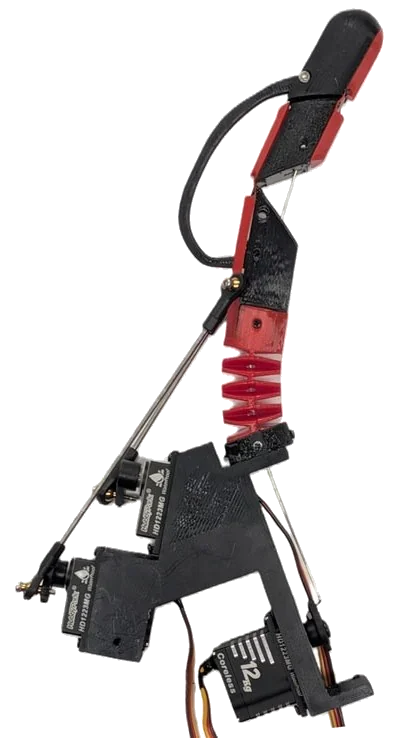
The root of each digit is a single printed TPU part shaped like the strain relief on a cable connector. It tilts in two directions, for flexion and side-to-side motion, while resisting twist.
Because it bends gently instead of folding sharply, a 0.6 mm spring steel rod can pass straight through its center to drive the upper two joints in both directions. Bending the hinge doesn't push or pull that rod, so the root joint and the upper joints are completely decoupled. Tilting the root never disturbs the finger's curl, and the reverse holds too.
Two RC servos tilt the root through two rigid drive rods and four ball joints, a layout that grew out of the classic planar 5-bar. A cross 4-bar couples the upper two joints at a ratio of 0.77, within the 0.75 to 0.8 range measured in human fingers. Its coupling rod runs outside the middle phalanx, so it can be shaped to add some passive compliance during contact.
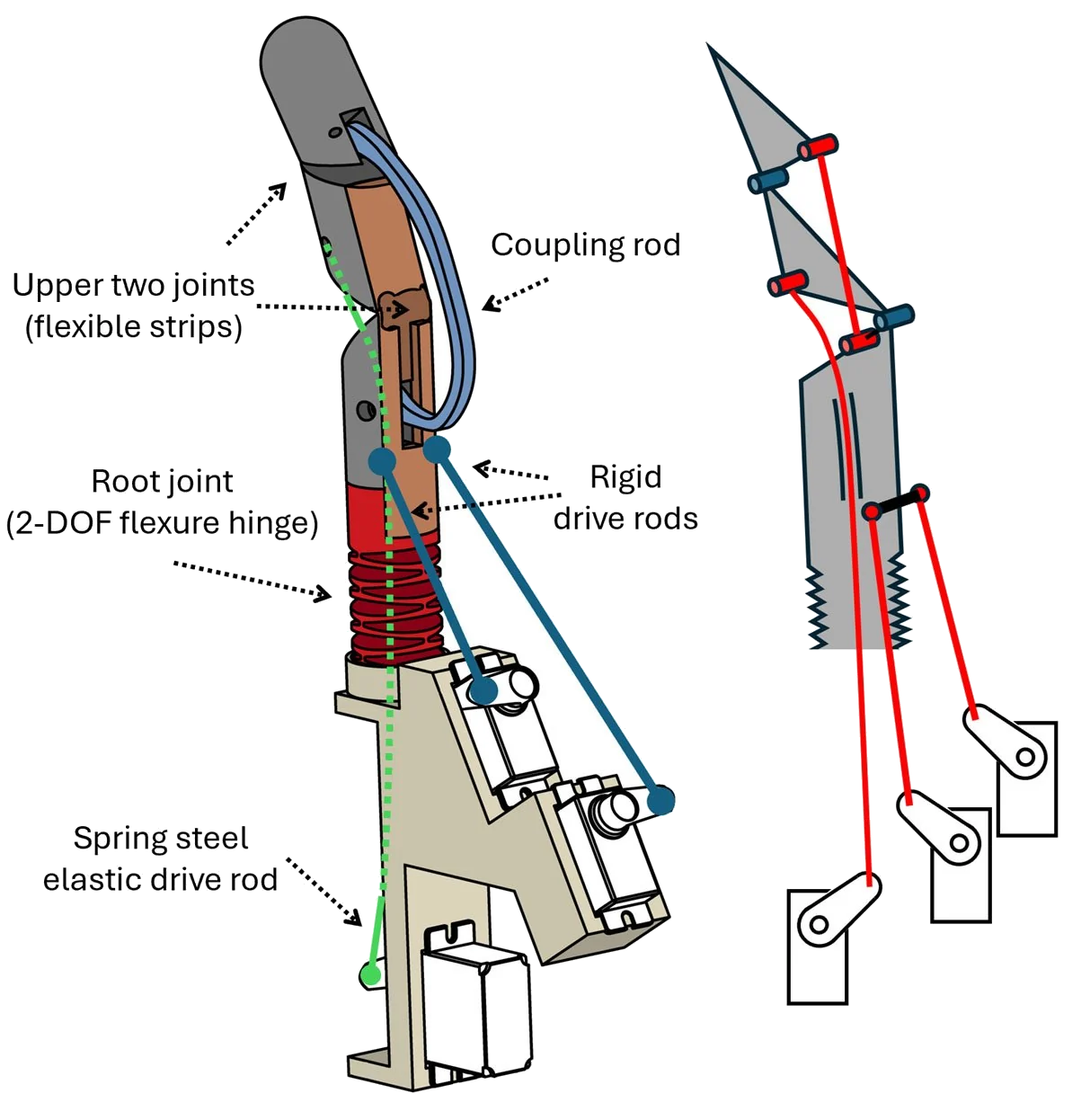
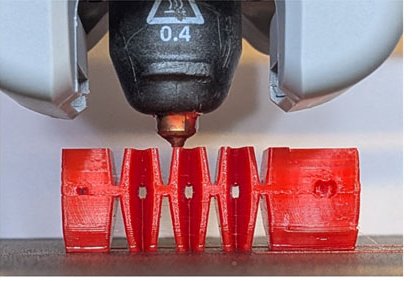
Print settings for the flexure
| Material | TPU 95A |
|---|---|
| Nozzle | 0.4 mm at 215 °C |
| Bed | 55 °C, with an enclosure |
| Speed | 100 mm/s |
| Layer height | 0.15 mm |
| Infill | 15% |
| Orientation | Horizontal, no supports |
How it compares
Against other hands that are fully linkage-driven, with at least three actuated DOFs per digit and all actuators off the digits.
| PHD-Hand | Kim et al. 2021 and follow-ups | Linkerbot L20 (commercial) | |
|---|---|---|---|
| Major parts per digit | 18 | 27+ | Unknown |
| Fabrication | DIY on a budget 3D printer | Industrial | Industrial |
| Root and upper joint kinematics | Completely decoupled | Partially coupled | Unknown |
| Backdrivable | Yes | No | Unknown |
| Hand length | About 190 mm | 218 to 255 mm | About 225 mm |
What it can do
Thumb opposition, the full GRASP taxonomy, and in-hand manipulation.
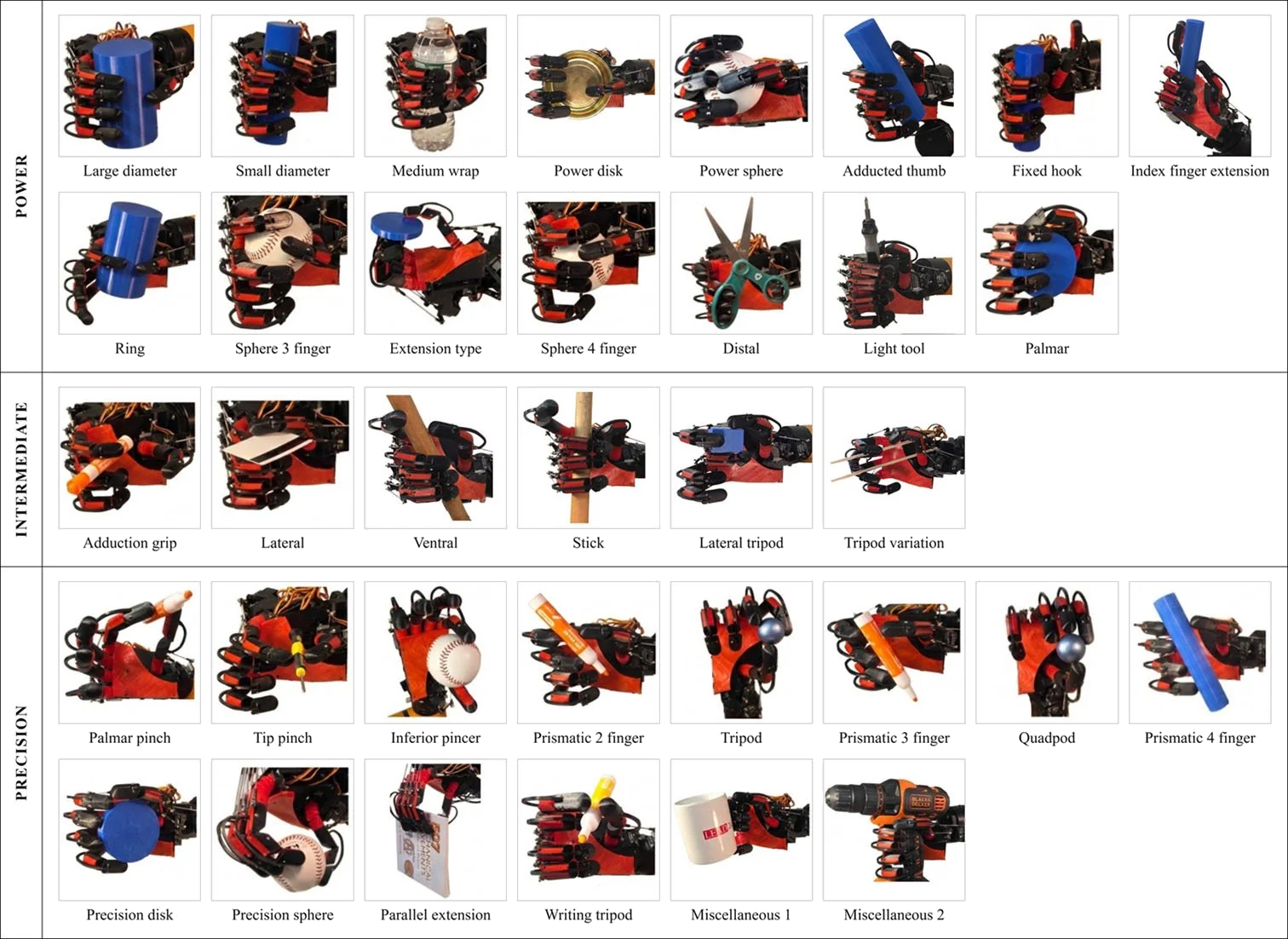
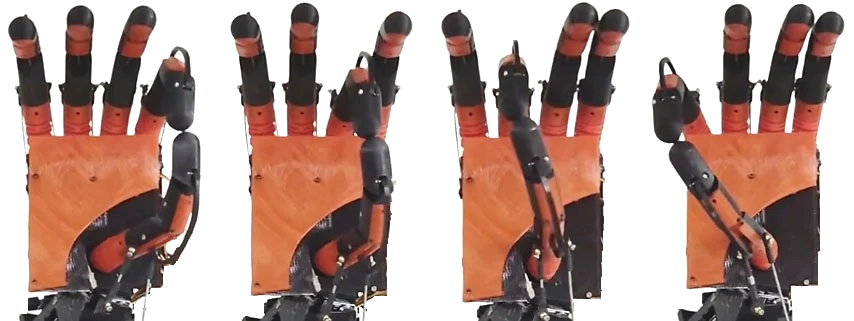
In-hand manipulation
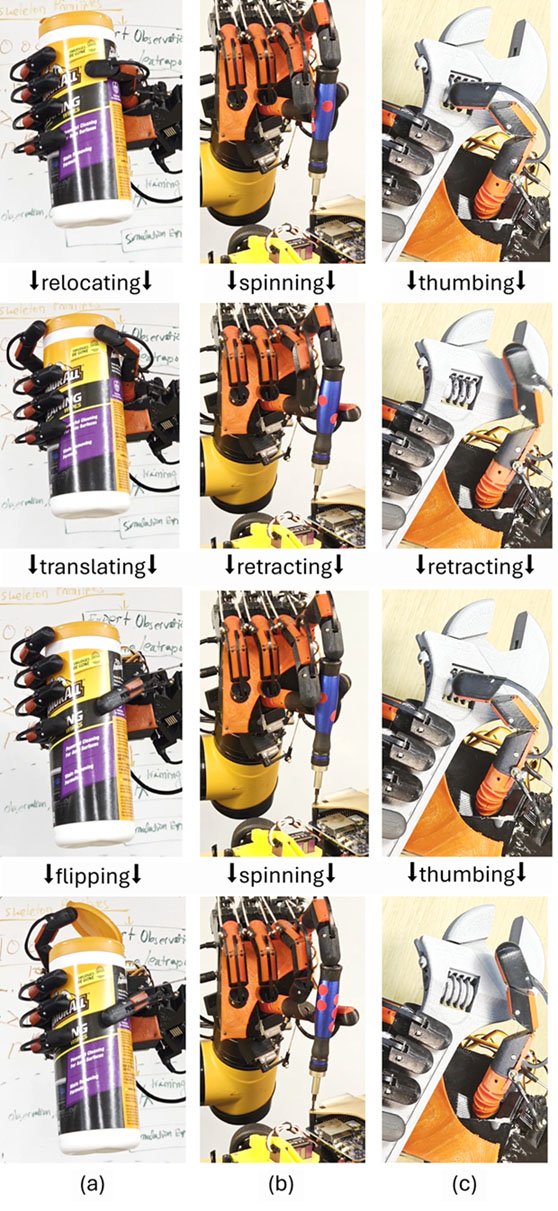
Relocate and flip. The hand shifts a jar in its grip until the index finger can reach the lid, then flips it open. That takes the thumb and index finger coordinating with the other three digits, plus the index finger's full range and strength.
Precision screwdriver. The thumb and middle finger alternate between retracting and spinning the driver without pushing it out of the index finger's hold.
Wrench worm screw. The thumb rolls the worm screw outward to close the jaws. Tendon-driven hands that rely on springs to extend their digits can't do this, so it shows true bidirectional actuation.
Control from the browser
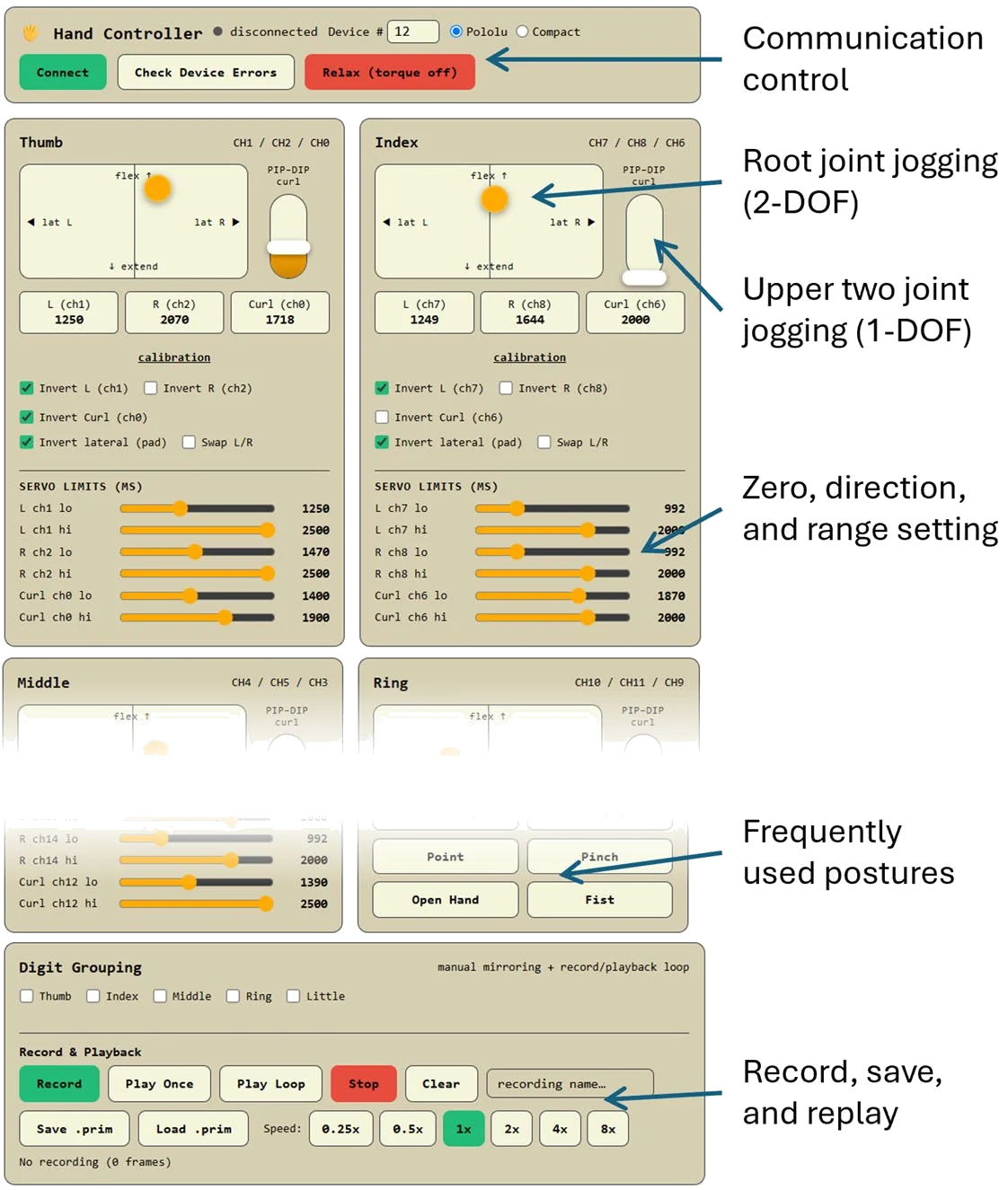
A web GUI talks to the Mini Maestro directly. Nothing to install.
- A 2-DOF pad per digit for jogging the root joint, plus a slider for the upper joints
- Calibration for the zero, direction, and range of every DOF
- Preset postures, and recording, saving, and replaying motions
The GUI and the motion trajectories, including the cube rotation above, were generated with Claude from a plain-text description of the hand and refined against the real prototype.
Files
Everything needed to print, wire, and run the hand, coming soon in the GitHub repo.
| Package | What's inside | Format | Status |
|---|---|---|---|
| CAD | Full hand assembly and editable models of every part, including the modular digits. | STEP, Fusion 360 | Coming soon |
| Print files | Print-ready parts with materials and settings: TPU 95A for the flexures and upper joints, PETG or TPU for the phalanges. | STL, 3MF | Coming soon |
| Control GUI | Browser controller with jog pads, calibration, preset postures, and record and playback. | HTML, JS | Coming soon |
| Motions | Saved postures and trajectories, including the in-hand cube rotation. | .prim | Coming soon |
| Bill of materials | Mini RC servos, Pololu Mini Maestro 18, ball joints, rods, pins, fasteners, 0.6 mm 304 spring steel wire, and filament. | CSV | Coming soon |
Build it
The full guide will come with the GitHub release. Here's the path from spool to working hand.
Print the parts
Print the flexure hinges and upper-joint strips in TPU 95A with the settings above, and the phalanges in PETG, or in TPU to make each digit body one piece.
Cut the drive rods
Cut the elastic drive rods from 0.6 mm 304 stainless spring steel wire, and shape the connectors with proper tooling, since a badly formed bend is the most likely place for a rod to break.
Assemble the digits
Each digit is a self-contained module with its three servos, so you can build, test, and swap them one at a time.
Wire and calibrate
Connect all 15 servos to the Mini Maestro using the channel map in the repo, then set each DOF's zero, direction, and range in the GUI.
Run it
Open the GUI in Chrome, connect to the Maestro, and try the preset postures or play back a recorded motion.
Papers
Cite the Humanoids paper for the full hand.
IEEE-RAS Humanoids 2026
PHD-Hand: A Printable Humanoid Dexterous Hand with Linkage-Driven 3-DOA Digits
New Jersey Institute of Technology
@inproceedings{adwani2026phdhand,
  title         = {{PHD-Hand}: A Printable Humanoid Dexterous
                   Hand with Linkage-Driven 3-{DOA} Digits},
  author        = {Adwani, Neel and Akash, Muhaiminul Islam
                   and Ouali, Saffia and Liu, Ethan
                   and Wang, Cong},
  booktitle     = {IEEE-RAS International Conference on
                   Humanoid Robots (Humanoids)},
  year          = {2026},
  eprint        = {2610.29030},
  archivePrefix = {arXiv},
  primaryClass  = {cs.RO}
}
MECC 2026
Dexterous Robot Hands with Linkage-Driven Three-DOF Fingers
Modeling, Estimation and Control Conference
The earlier paper that introduced the flexure root joint, with a preliminary three-digit prototype and strength tests.
@inproceedings{adwani2026dexterous,
  title     = {Dexterous Robot Hands with Linkage-Driven
               Three-{DOF} Fingers},
  author    = {Adwani, Neel and Ouali, Saffia
               and Orlowski, Mateusz and Liu, Ethan
               and Wang, Cong},
  booktitle = {Modeling, Estimation and Control
               Conference (MECC)},
  year      = {2026}
}
Maintained by Neel Adwani · LinkedIn
GitHub repository coming soon.